AI-powered marketing is no longer a concept on the back burner or a tool used only by large companies. By 2026, it had become a practical way to understand customers, produce content, optimize ads, and close sales opportunities more quickly. But the real value doesn’t come from buying a new tool; it comes from aligning AI with a clear business objective, reliable data, and human oversight that safeguards the quality of decision-making.
Today’s marketing teams face increasing pressure. There are more channels, competition is fiercer, and the cost of reaching customers can rise rapidly. At the same time, data is scattered across the website, ad platforms, social media accounts, email, and the customer relationship management (CRM) system. Therefore, the team needs a way to connect these signals and turn them into actionable priorities.
This guide explains how your company can use artificial intelligence to boost campaign efficiency and increase sales, without sacrificing your brand’s voice or customer privacy. It also provides clear metrics, a phased implementation plan, and pitfalls to avoid before scaling up your investment.
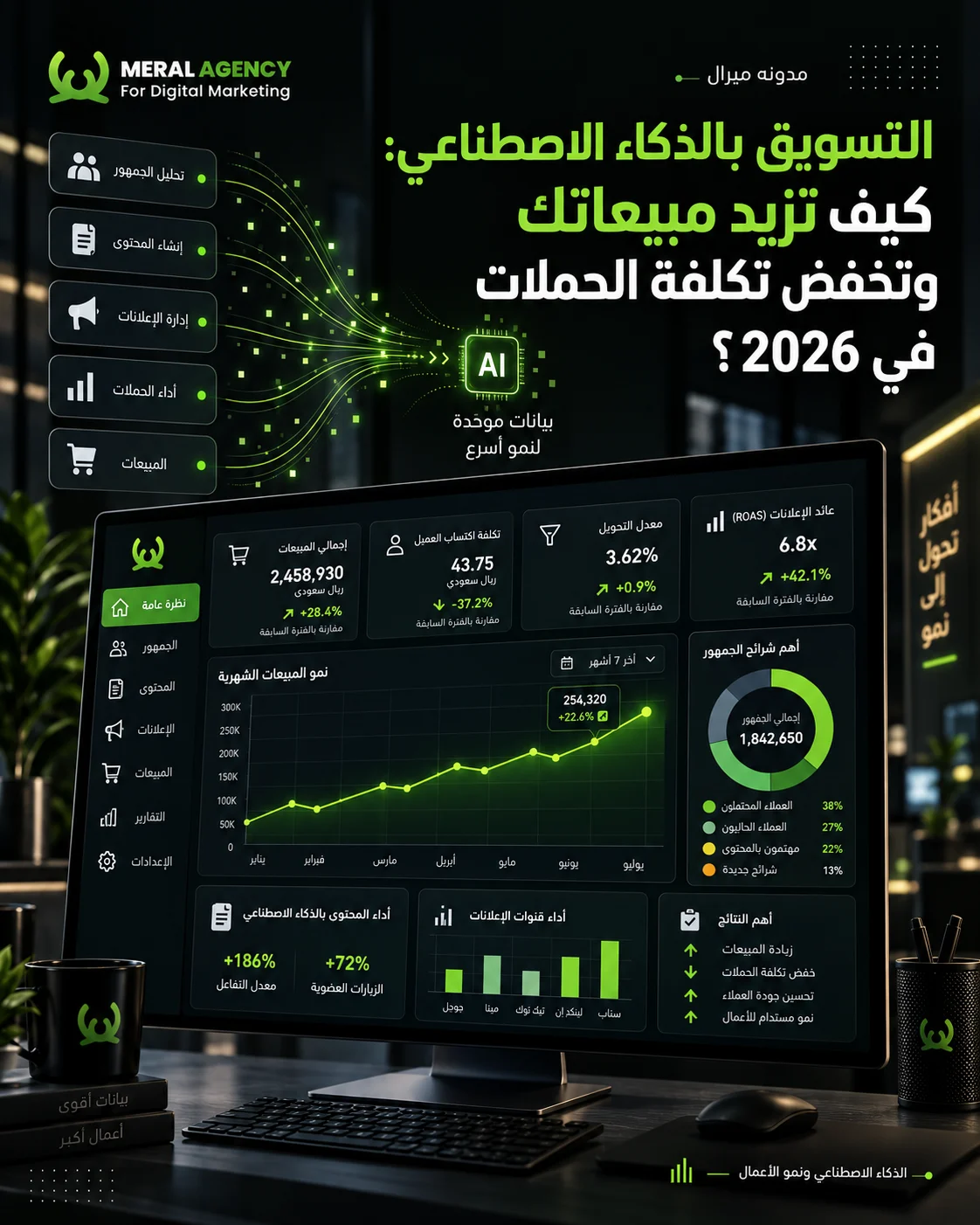
What is AI marketing?
It is the use of technologies capable of analyzing large amounts of data, discovering patterns, making predictions, or helping teams create drafts of text, images, and reports. This may include segmenting audiences, suggesting offers, predicting purchase likelihood, optimizing ad bids, analyzing conversations, or summarizing campaign performance.
However, effective use does not mean handing over all decisions to the system. The tool can quickly sort through options, while humans define the goal, context, and risk limits. For this reason, the best model combines automation for repetitive tasks with human expertise in strategy, creativity, and review.
Why Will AI-Powered Marketing Be Important in 2026?
The customer journey is changing rapidly. A person might see an ad on a social media platform, then search on Google, read reviews, and return to the website days later before placing an order. It’s difficult for manual analysis to track this journey and understand the impact of each touchpoint, especially when a company is running multiple campaigns at the same time.
AI helps uncover relationships within this data, but it doesn’t create a strategy out of thin air. You must first define the desired outcome: Is the goal to increase qualified orders, raise the average order value, reduce churn, or improve customer retention? The more specific the goal, the easier it is to test and measure the recommendations.
- Speed of analysis: Analyzing thousands of interactions and identifying patterns that are difficult to spot manually.
- Better personalization: Delivering a message or offer that’s more closely tailored to the needs of each segment.
- Greater efficiency: Reduce the time spent on reporting, drafts, and repetitive tasks.
- Measurable Decisions: Link recommendations to metrics such as conversion, revenue, and customer acquisition cost.
Start with the data before choosing an AI tool
Before using any platform, review the quality of the data you’ll be relying on. If campaign names are inconsistent, conversion events are incorrect, or customer data is duplicated, the system will learn from an incomplete picture. Consequently, it may provide a mathematically accurate recommendation that is nevertheless unsuitable for the business reality.
Start with a source map: website, ad platform, traffic analytics, email, conversations, sales, and customer service. Then agree on consistent definitions for terms such as qualified lead, completed sale, and customer acquisition cost. Next, determine which data can be used and which should be protected or excluded.
This step doesn’t require a massive project. You can start with data from a single campaign and a single product, then scale up once you’ve verified that tracking is accurate. It’s important that the comparison is fair, and that the team knows who reviews the data and who approves changes to the budget or messaging.
AI-Powered Marketing and Customer Segmentation
Traditional segmentation often relies on age, location, or general interests. Advanced analysis, however, incorporates user behavior: the pages they viewed, the time of their visit, the products they compared, purchase frequency, their response to offers, and the types of questions they ask before making a decision. By gathering these signals, the team can build more useful segments.

A service company, for example, might discover that customers who visit the pricing page twice and read a case study are more likely to request a consultation. In that case, the company can send content that addresses their concerns rather than repeating a generic advertisement. In an online store, the shopping cart and browsing history can be used to suggest complementary products, while avoiding excessive messaging that erodes trust.
Successful personalization delivers clear value without making the customer feel monitored. Therefore, you should use only the minimum necessary data, clarify privacy options, and review segments periodically so that outdated assumptions do not become set in stone.
Create Content Faster Without Losing the Brand’s Voice
AI can help the content team collect frequently asked questions, organize ideas, suggest an outline, prepare a first draft, or convert long-form content into multiple formats. This saves a significant amount of time, especially when a company needs content for its website, emails, ads, and social media platforms.

However, publishing directly creates obvious problems. The information may be too general, the tone inconsistent, claims unsubstantiated, or examples far removed from the local market. Therefore, content must go through a consistent workflow: a clear brief, reliable sources, drafting, expert review, copyediting, brand voice checking, and then measuring the results after publication.
A brand voice guide helps improve quality. Document the words your company uses, the words it avoids, headline styles, the level of formality, and how promises are presented. Then measure content performance based on qualified visits, outreach requests, and subscriptions—not just the number of pieces published.
AI-Powered Marketing to Optimize Advertising Campaigns
Advertising systems can analyze numerous signals when determining bids, selecting audiences, or allocating budgets. However, these systems require sound conversion goals and a clear value assigned to each outcome. If the platform assigns the same value to a thank-you page visit as it does to a sale, the campaign may improve a metric that doesn’t translate to company profits.

Start by reviewing conversion events, then distinguish between primary and secondary conversions. Next, monitor the cost per qualified customer, sales value, and return on spend—not just clicks. This methodology can be integrated with the fundamentals of social media account management and brand messaging to ensure a consistent experience from the ad to the landing page.
It’s also helpful to conduct systematic tests. Change one key element in each test—such as the offer, headline, or landing page—and define the duration and sample size before drawing conclusions. Then use the system to accelerate the discovery of the best version, not to justify daily budget changes without sufficient data.
How do you reduce customer acquisition costs?
Costs decrease when multiple parts of the funnel improve together: more precise targeting, a clearer message, a faster page, a shorter form, and better follow-up. An ad may drive good traffic, but delays in reaching out to potential customers can waste that traffic. Therefore, you must link ad data to actual sales results so the algorithm knows which customers deliver value.
When Is Automation Not the Solution?
If conversion volume is too low, tracking is incomplete, or the offer itself is unclear, automation won’t address the root of the problem. In this case, fix the measurement, the page, and the offer first. Then use smart tools once you have enough data to identify a genuine pattern rather than chasing random signals.
Qualifying Leads and Aligning Marketing with Sales
Not all leads are created equal. Some customers are just starting their search, some are comparing vendors, and some are ready to make a decision. A lead scoring model can rank opportunities based on their behavior and fit for the service, then prioritize them for the sales team with a clear rationale.
A customer might earn points by visiting a service page, downloading a guide, opening specific emails, or requesting a quote. However, the scoring should not rely solely on digital interactions; company size, budget, timing, and region may also be important factors. The results should also be reviewed with the sales team, as their feedback reveals whether the model is actually identifying good opportunities.
When the customer management system is linked to campaigns, the company can identify which channel brought in a deal—not just a lead. This connection prevents cutting the budget for a channel that may seem costly at first but attracts higher-value customers in the long run.
Measuring Marketing ROI with AI
It’s not enough to measure the time the tool has saved. You must link its use to a business outcome before scaling up. Start with a baseline that describes the current situation, then select one key metric and two supporting metrics. For example, the key metric might be the cost per qualified lead, while you monitor the conversion rate and average follow-up time as supporting factors.
Compare a group using the new workflow to a control group or baseline period, and calculate the costs of the tools, integration, review, and training. Then ask: Have revenue or quality improved? Has time been reduced without increasing errors? And can the team replicate the result? These questions help distinguish real improvement from temporary enthusiasm.
Management can compile these metrics into a single dashboard and review them weekly. If the company needs a broader strategy, integrated marketing packages illustrate how content, campaigns, and design can be coordinated rather than running each channel in isolation.
Human Oversight, Privacy, and Accuracy of Results
Every use case requires a human administrator to review the outputs and have the ability to pause them. This rule is crucial when drafting a marketing claim, adjusting a large budget, using customer data, or sending a message on behalf of the company. Changes should also be logged so the team knows what the tool suggested and what a human approved.
Establish a policy specifying which tools are approved, the types of data permitted for input, retention periods, and the level of review required before publication. Also review the terms of service for the platforms and the requirements of the market in which you operate. You can use NIST’s AI Risk Management Framework to develop governance questions, and Google’s resources on AI to understand general uses and developments.
Do not enter sensitive data into an unapproved tool, and do not rely on a single output for high-impact decisions. Check for accuracy, bias, and consistency of tone, and keep a record of the source of every piece of important information. This way, AI becomes a disciplined assistant rather than a new source of errors.
A Six-Step Plan for Implementing AI in Marketing
- Choose a single goal: such as lowering the cost per qualified lead or reducing content creation time.
- Document the baseline: Record current results, costs, and time before making any changes.
- Review the data: Fix tracking issues, duplicate entries, and missing definitions.
- Conduct a limited trial: Apply the solution to a single campaign, product, or segment.
- Include human review: Designate who approves messages, budgets, and data.
- Measure and scale: Expand usage only when results are consistent and quality remains stable.

This plan prevents the team from purchasing multiple tools before defining the problem. It also makes the discussion more practical; instead of asking, “How do we use AI?” the question becomes, “How do we reduce customer follow-up time from one day to one hour, and what data do we need to prove it?”
A Practical Plan for the First 30 Days
In the first week, choose a single customer journey and map out its steps from the first interaction through to the sale. In the second week, review the tracking, clean up the data, and define the criteria for success. In the third week, run a small experiment with a control group. In the fourth week, analyze the results, document the lessons learned, and decide whether to adjust or scale up.
The experiment could involve setting up an automated weekly summary of campaign performance, organizing outreach requests, or producing drafts for three types of content. Keep the task specific, keep a record of the previous process, and don’t change more than one key factor at a time. This way, you’ll know the source of the improvement rather than attributing every result to the tool.
Common Mistakes When Using AI in Marketing
The first mistake is to start with the tool instead of the problem. The second mistake is relying on unreliable data. Companies also fall into the trap of producing large amounts of similar content, changing campaigns too quickly, or letting the system run without clear limits on budget and permissions.
Another mistake is measuring superficial metrics. The number of visits or posts may increase while orders and sales remain flat. Therefore, link every experiment to a business metric, and review customer quality—not just their number. Also, don’t forget to train your team; employees need to know how to define the task, verify the outcome, and document the decision.
Finally, don’t overlook the customer experience. If messages become overly automated or offers are repeated out of context, engagement may decline despite improved production speed. Successful technology makes communication clearer and more useful—it doesn’t make the brand less human.
How Can Companies in Saudi Arabia and the Gulf Benefit?
Companies in the region operate in fast-growing, multichannel markets, where customers use both Arabic and English and compare local and global experiences. Therefore, smart tools are useful for analyzing audience questions, tailoring messages by city or sector, and tracking campaigns across multiple markets. However, language, tone, and cultural context must be reviewed before publication.
Service-based companies, in particular, need to link advertising to a phone call, appointment, or transaction, since engagement alone does not equate to a sale. Retailers can link campaigns to order value and repeat purchases. As for startups, they can use automation to reduce manual tasks while ensuring that the founder or an expert reviews key messages. The 2026 Marketing Guide for Companies in Saudi Arabia provides a broader context for building a comprehensive digital presence.
Frequently Asked Questions About AI Marketing
Is it suitable for small businesses?
Yes, provided you start with a specific problem. A small business can use it to summarize campaign reports, organize content ideas, or prioritize outreach requests. You don’t need a complex system to get started; you need accurate data, a clear metric, and human review.
Will it replace the marketing team?
More likely, it will change the way the team works. Some repetitive tasks will decrease, while strategy, editing, verification, and results analysis will become more important. A team that learns to manage and review these tools can produce better work in less time.
How much data do we need to get started?
It depends on the situation. You can start with content and summaries even with limited data, but predicting and automatically optimizing campaigns requires a sufficient volume of conversions. If the volume is small, use simple rules and clear tests before building a complex model.
What’s the most important metric to track?
Choose the metric closest to your business goal. It could be cost per qualified lead, sales value, retention rate, or time to task completion while maintaining quality. Avoid relying on clicks and reach if you don’t link them to a subsequent outcome.
How do we maintain content quality?
Use a clear brief, reliable sources, and a brand voice guide, then have an expert and an editor review the content before publishing. Afterward, monitor reader behavior and conversions, and update the content when information or market needs change.
Conclusion: AI Is a Tool for Better Decision-Making
AI-driven marketing succeeds when it starts with a clear goal, relies on sound data, and operates within defined parameters and under human oversight. Only then can the team understand the audience more accurately, produce better content, allocate the budget efficiently, and help the sales team pursue the highest-value opportunities.
Don’t start with ten applications. Start with a single experiment that can be measured within weeks, document the baseline, and then scale what proves effective. Miral Marketing Solutions can help you build a strategy that connects data, content, campaigns, and sales—so that AI transforms from a tech buzzword into measurable growth.